
Mallorca’s landscape is also defined by its olive trees. Their fruit gives rise to a product deeply connected to the island’s history and cuisine: Mallorca olive oil.
Mallorca Olive Oil, the Essence of Mediterranean Cuisine
Mallorca olive oil is part of a gastronomic tradition in which local produce, simplicity and Mediterranean flavours take centre stage.
A Product Shaped by Its Territory
During the 17th, 18th and 19th centuries, olive oil became one of the main sources of wealth for many Mallorcan estates, with production exported from the island’s ports to other Mediterranean and European markets.
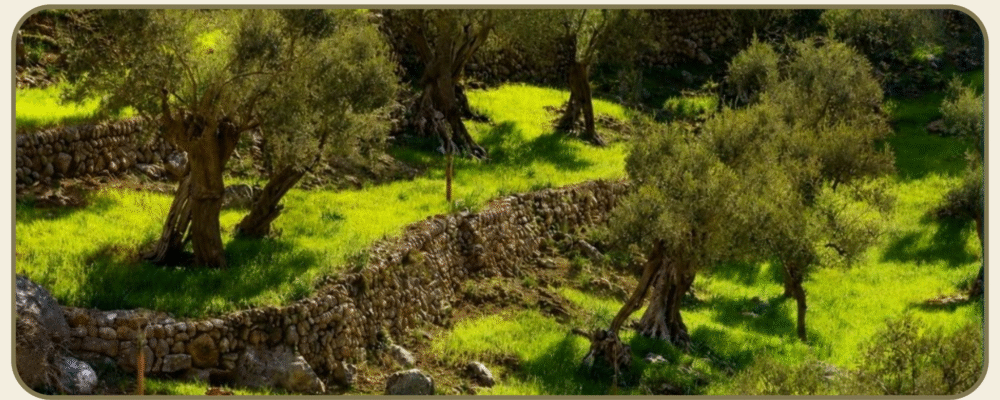
Today, olive trees remain an essential part of the island’s landscape, from the Serra de Tramuntana to other agricultural areas. The Mediterranean climate, soils and terrain all influence the characteristics of the olives and the oil produced from them.
In the kitchen, olive oil is inseparable from some of Mallorca’s most recognisable dishes. A good oil accompanies pa amb oli, vegetables, fish and many other dishes from Mediterranean cuisine.
How Mallorca Olive Oil Is Produced
The production of Mallorca olive oil begins in the olive grove and continues at the olive mill, where the care taken with the olives directly influences the final result.
From the Olive Tree to the Olive Mill
The harvest usually takes place between October and January, depending on the area and the conditions of each season. Once harvested, the olives are taken to the olive mill for cleaning and subsequent milling. The oil is extracted using physical processes, without chemical treatments.
At olive mills registered under the Oli de Mallorca Designation of Origin, continuous extraction systems using centrifugation are used. The oil is then stored in tanks protected from light and kept at a suitable temperature to preserve its characteristics.
The timing of the harvest, the condition of the olives and the time between harvesting and extraction all influence the final result. Each oil therefore also reflects the care taken from the olive grove through to its production.
The Varieties of Mallorca Olive Oil
Olive varieties account for much of the diversity found in Mallorca olive oil. The Designation of Origin recognises four varieties: Mallorquina, Arbequina, Empeltre and Picual.
Four Varieties, Different Profiles
The Mallorquina variety is one of the defining characteristics of the island’s olive oil. Particularly well adapted to the local territory, it produces smooth, sweet oils with notes of ripe almond. Arbequina offers green fruit notes, while Empeltre stands out for its delicacy and almond nuances. Picual has a more intense profile, with bitter and spicy sensations.
This diversity means that there are oils ranging from mild to more intense profiles. There are also single-variety oils and blends that combine different olives. The Oli de Mallorca D.O. has held its designation since 2002, guaranteeing the origin and production of the oil within the protected geographical area.
Producers Representing Mallorca Olive Oil
Different producers are keeping Mallorca’s olive oil culture alive through projects that combine agricultural tradition, careful olive grove management and new ways of working with the product.
Quality, Flavour and Tradition
Oliuga, specialising in organic extra virgin olive oil, is part of Mallorca’s current olive oil scene. Its presence at the 2026 Fira de l’Oli de Mallorca, alongside producers such as Aubocassa, Treurer, Son Matge, Picarandau, Sa Marina and the Cooperativa de Sóller, reflects the diversity of producers found across the island.
Also working in organic production, Son Moragues operates from its estate in Valldemossa, where it cultivates olive trees of the Mallorquina variety. The project is also closely connected to the recovery of the agricultural landscape of the Serra de Tramuntana.
The diversity of producers is reflected in oils with different profiles and in the various ways olive trees are cultivated and oil is produced in Mallorca. Some estates and olive mills also offer visits and tastings, allowing visitors to discover the cultivation, production process and characteristics of their oils at first hand.
Sa Creu Nova, a Starting Point for Discovering Mallorca
Mallorca olive oil is part of a gastronomic culture that can also be discovered by exploring the island’s inland landscapes and villages.
The Territory Can Also Be Savoured
A route through the olive groves offers a glimpse of a Mallorca shaped by agricultural estates, dry-stone walls and small villages that preserve much of the island’s rural identity. The olive-growing landscape changes with the seasons, but it always retains that connection between agriculture and the land that defines much of inland Mallorca.
After exploring these landscapes, Tess de Mar continues this journey through Mediterranean cuisine based on local, seasonal produce, where Mallorcan olive oil also finds its place among the flavours that define the island.