
Close to one of Mallorca’s best-known beaches lies a landscape where time has barely altered an activity that began centuries ago. The Es Trenc Salt Flats offer a different way to discover the island’s natural and cultural heritage.
What Makes the Es Trenc Salt Flats So Special
The Es Trenc Salt Flats occupy a protected area where nature and tradition remain closely connected. This unique corner of southern Mallorca is far more than a place where salt is produced. It forms part of one of the island’s most distinctive landscapes.
A Landscape Shaped by Salt
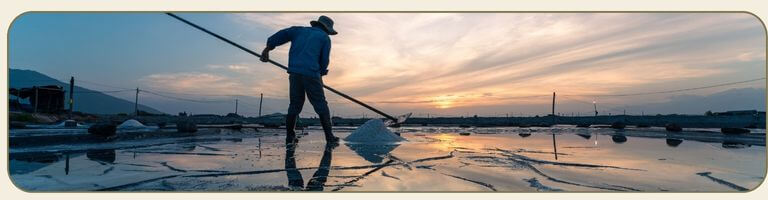
Salt has been harvested in this area for more than 2,000 years. Although the activity has evolved over time, traditional salt-making methods remain largely unchanged.
Seawater from the nearby Es Trenc Beach flows through a network of channels and evaporation ponds, where the sun and wind encourage a completely natural evaporation process. This is how the renowned Flor de Sal d’Es Trenc is formed, harvested by hand and dried naturally in the sun without any further processing. Considered the finest salt crystal that forms naturally on the surface of the water, it can only be collected when weather conditions are favourable.
All of this takes place within the Es Trenc-Salobrar de Campos Natural Park, one of the Balearic Islands’ most important wetlands.
Flamingos, herons, avocets and black-winged stilts use this area as a resting place throughout much of the year, while salt-tolerant plants such as glasswort and sea lavender thrive in the surrounding landscape. With every season, the scenery changes, creating one of southern Mallorca’s most distinctive natural environments.
Is It Worth Visiting the Es Trenc Salt Flats?
If you’re looking to discover a lesser-known side of Mallorca, the Es Trenc Salt Flats are one of the most unique places to visit in the south of the island.
Much More Than a Salt Production Site
Walking through the Es Trenc Salt Flats reveals why this landscape has remained connected to salt production for centuries. The route follows the journey of the seawater through the evaporation ponds while introducing visitors to the work of the salt workers, whose traditional techniques have changed very little over time.
The Flor de Sal d’Es Trenc is widely appreciated both in everyday cooking and in fine dining for its delicate texture and its ability to enhance flavours without overpowering them. This exceptional quality has made it one of Mallorca’s best-known gastronomic products.
The coexistence of salt production and a protected natural environment has defined the identity of the Es Trenc Salt Flats for centuries. This close relationship between tradition and nature is one of their most distinctive features.
Walking through the salt flats also offers a new perspective on the landscape. The wetlands, the birdlife and the ever-present Mediterranean help visitors understand that salt is only one part of an environment of outstanding ecological value.
At the salt flats’ shop, visitors can purchase different varieties of Flor de Sal d’Es Trenc along with other products made in this unique setting.
Es Trenc Beach and Ses Salines
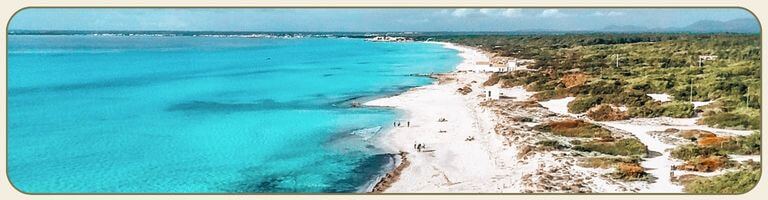
The close proximity of these two places makes it possible to explore a protected wetland and one of Mallorca’s most iconic beaches in a single morning. Few places on the island combine such a rich natural heritage within such a short distance.
Two Landscapes Connected by the Mediterranean
While Es Trenc Beach is renowned for its long stretch of white sand and crystal-clear waters, the salt flats reveal the patient process through which the sea, the sun and the wind transform seawater into salt.
Visiting both places highlights the close relationship between the coastal landscape and an activity that has shaped this part of Mallorca for generations. Spring and autumn are particularly pleasant seasons to explore the area, when the mild weather invites visitors to discover it at a leisurely pace.
Sa Creu Nova, Close to the Es Trenc Salt Flats
The proximity of Sa Creu Nova to this protected landscape makes it easy to discover one of the most distinctive areas of southern Mallorca without travelling long distances.
A Peaceful Retreat After Your Visit
After a day spent exploring the salt flats, walking through nature trails and enjoying the Mediterranean landscape, returning to Sa Creu Nova becomes a natural continuation of the experience. The hotel’s traditional Mallorcan architecture, its peaceful atmosphere and the gastronomic proposal of Tess de Mar, inspired by seasonal local ingredients, extend this slower way of discovering Mallorca, deeply connected to the landscape and the tranquil rhythm of the island’s interior.